





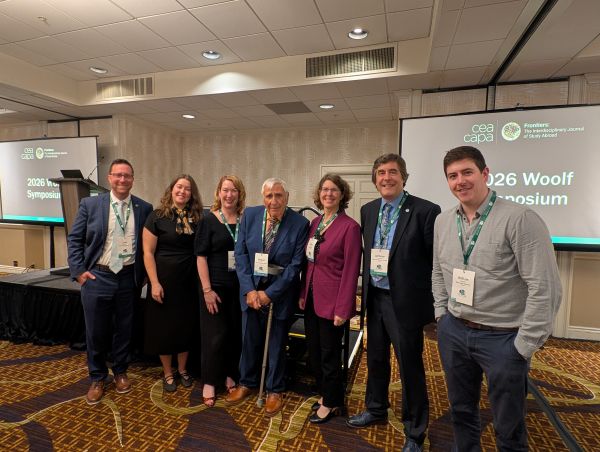
Members of the 2026 Woolf Symposium Organizing Committee including, from left to right, Drs. Louis Berends, Amelia Dietrich, Martha Johnson, Michael Woolf, Elaine Meyer-Lee, and Anthony Gristwood, and panel leader W. Patrick Bingham, PhD
What does the word “global” mean anymore? Is it a good word? Or a bad word? Who has the final say about what words we use to describe our work, anyway? These questions and many others were explored in the 2026 Woolf Symposium, hosted by CEA CAPA Education Abroad and Frontiers: The Interdisciplinary Journal of Study Abroad ahead of The Forum on Education Abroad’s annual conference in Nashville, TN.
On March 10, 2026, professionals from across the globe—representing a wide spectrum of organizations, roles, and perspectives—gathered for this year’s Woolf Symposium: Keywords in Education Abroad Storytelling: Deconstructing the Language of the Field. The event sparked a dynamic, thought‑provoking exchange about the vocabulary that shapes our work, the assumptions embedded within it, and the ways intentional language can strengthen both the field and the students we serve.
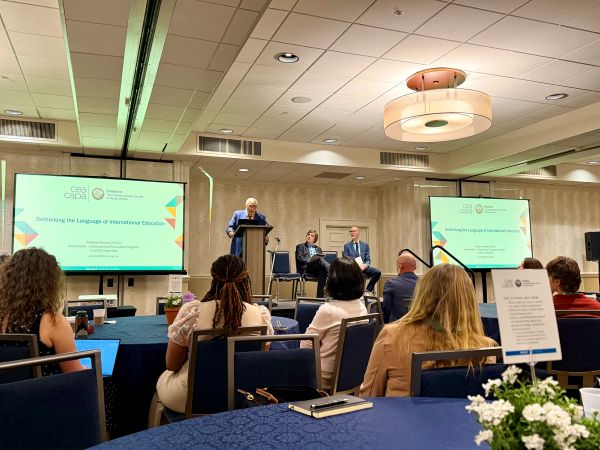
Symposium namesake Michael Woolf, PhD, asked the audience to unlearn, reconsider, and deconstruct previously held notions in education abroad.
This year’s symposium carried particular significance as it marked the first co‑hosted collaboration between Frontiers and CEA CAPA. Amelia J. Dietrich, Ph.D., Managing Editor of Frontiers, and Martha Johnson, Ph.D., Chief Academic Officer and Provost for CEA CAPA Education Abroad, opened the program by welcoming attendees and celebrating CEA CAPA’s new role as a sponsoring partner of the journal. Their remarks set the tone for a day centered on collaboration, reflection, and the evolving language of education abroad.
Opening speaker Anthony Gristwood, PhD, Senior Editor of the CEA CAPA Occasional Publications Series, captured the heart of the conversation with a simple but powerful reminder: words have power.
Take, for example, the word “reentry.” For a study abroad professional, the word might bring to mind the process of returning to a home campus and thus reacclimating to the familiar grooves of life before a study abroad experience. But Angelina Rodríguez, PhD, Assistant Vice Provost for Global Learning at Lehigh University, wondered if there isn’t some element of violence in this term, evoking an astronaut’s fiery return to our atmosphere at an extremely high speed. As we are the experts in cultural exploration, might we shift from “reentry” to “integration”? Joining her on a panel focused on this keyword (reentry) was Nolan Rachocki, a graduate student at Michigan State University whose first true semester on his home campus was in his third year of study. His first academic year was held fully online thanks to the COVID-19 epidemic, and his second academic year was spent studying abroad. Reentry, in his case, was a farce—there was no campus to return to, rather one to discover for the first time. Rachocki’s suggested alternatives to “reentry” included “orienting,” “self-situating” (a more inward-facing term), and even “transitioning forward.”
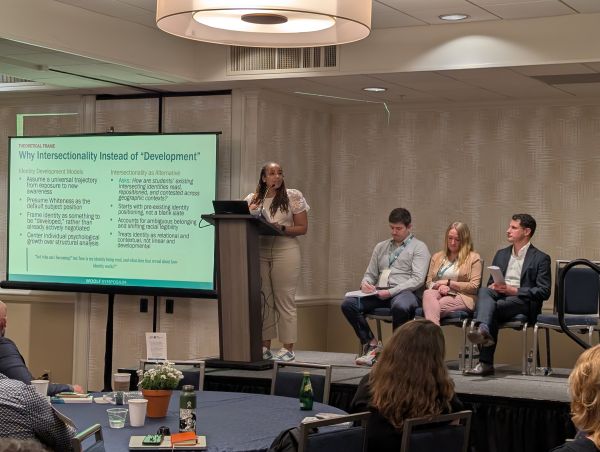 Andrea Lewis, PhD, challenged the idead of "identity development" and encouaged attendees to consider "intersectionality" as an alternative approach.
Another keyword that sparked conversation on panels and among the audience was “access.” While some would accept that this word has carved a permanent place in the lexicon of study abroad administrators and higher education professionals alike over the past decade, some panelists questioned whether the required action truly lies behind the utilization of this word. To this point, Angela Schaffer, Executive Director for the Fund for Education Abroad, posed the question, “What do students actually access: opportunity, or just opportunity language?” When, as a field, we say we are implementing “access” in our programs by making them shorter, for example, but not carrying over necessary funding or follow-on support, is that really access?
The symposium’s eight panelists challenged the audience to rethink what words we hold dear, which may cause harm, and which might be revisited to ensure that they match the current and future landscape and the environment in which we presently live.
To summarize the day’s findings, Lily Lopez-McGee, PhD, Senior Director of Diplomatic Fellowships at Howard University, reminded attendees what our opening speaker led with: words have power. As a field, we are indeed attached to certain terms, and they can evoke both positive and negative feelings. We sit in a moment of opportunity where we can engage in the practice of reexamination of said keywords, make the implicit explicit, and make it abundantly clear why we use each term. Language, she shared, necessarily evolves, and it has the capability to replicate the systems of power and privilege if we let it. We have a choice with the language we use every day, she said. If the language no longer works, let’s change it.
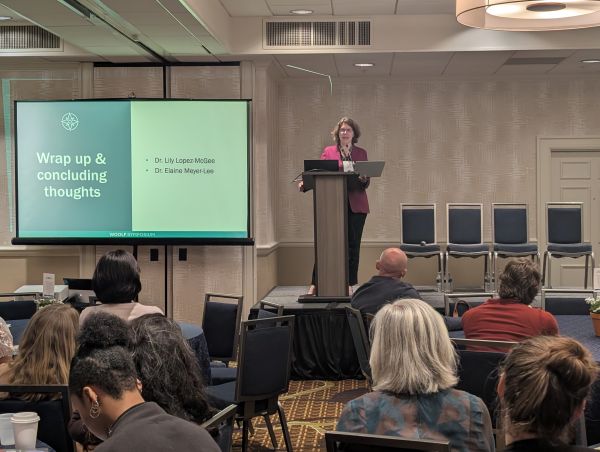 Dr. Elaine Meyer-Lee, Editor of Frontiers, celebrated the partnership between Frontiers and CEA CAPA to continue this crucial critical analysis to keep our field moving forward.
At its core, the Woolf Symposium is meant to generate new knowledge, connect attendees to facilitate joint research opportunities, and continue to disrupt the notion of “the way it’s always been done” so that we might join together to create a new, better path forward. Frontiers has been highlighting voices and research specific to education abroad for 30 years, and with the CEA CAPA Occasional Publication series now being published by Frontiers, we welcome inquiries from individuals and organizations that share our commitment to advancing the knowledge-building dialogue around education abroad and student mobility.
Interested parties can reach out to us at frontiersjournal@forumea.org to learn more, and we hope you will keep an eye out for the next call for submissions to the Occasional Publication—especially if you feel inclined to (re)examine a keyword.