









CIS Abroad has joined forces with
CEA CAPA Education Abroad
As part of the CEA CAPA Education Abroad family, you'll find even more opportunities with our expanding global network.

Barcelona SAE has joined forces with
CEA CAPA Education Abroad
As part of the CEA CAPA Education Abroad family, you'll find even more opportunities with our expanding global network.
Wind and Photovoltaic Generation
Engineering & Social Sciences Program
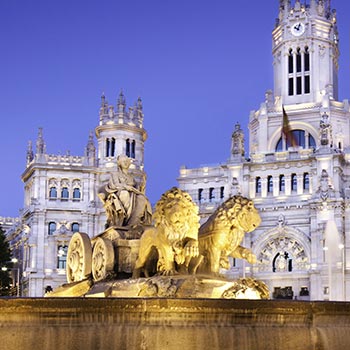
Madrid, Spain
Dates: 1/16/25 - 6/4/25
Wind and Photovoltaic Generation
OVERVIEW
CEA CAPA Partner Institution: Universidad Carlos III de Madrid
Location: Madrid, Spain
Primary Subject Area: Electrical Engineering
Instruction in: English
Course Code: 18339
Transcript Source: Partner Institution
Course Details: Level 300, 400
Recommended Semester Credits: 3
Contact Hours: 42
Prerequisites: Electrical Fundamentals, Electrical machines
DESCRIPTION
MODULE 1: PHOTOVOLTAIC (PV) SYSTEMS
PV 1-Introduction to solar energy
1.1- Solar energy all over the world
1.2-Resource
PV 2. Basic Technology.
2.1- Solar cell. Basic principles and current technology.
2.2- Characteristic of the solar cell. Exercises solar cell, cell temperature.
PV 3. Solar panels
3.1- Solar panels.
3.2-Generators electrical characteristic of photovoltaic solar panels. Varying voltage of the photovoltaic panels. Testing.Characteristic curve with variation of irradiance and cell temperature.
3.3 Architectural integration.
3.4 Solar tracking
PV 4-Inverters.
4.1-Types and functions. Performance.
4.2-Regulation
4.3- Tracking the maximum power point of photovoltaic generrador (MPPT)
PV 5- Autonomous photovoltaic systems.
5.1 -Components. Batteries. Charge regulators. Inverters.
5.2- Autonomous photovoltaic systems: and dimensioning schemes.
5.3-Sizing exercises depending on the location and energy requirements.
5.4- Project; complete sizing
PV 6. Photovoltaic Systems PV grid connected.
6.1 Schemes
6.2-Photovoltaic systems connected to the grid. Protections.
6.3-Regulations.
6.4- Sizing with specific software (PVSYST).
PV 7 Net balance.
7.1- Schemes
7.2- Characteristics. Examples
MODULE 2. WIND POWER
WIND 1. Wind Energy. Current status and resources.
1.1- Current status of wind power around the world
1.2- Wind resource. Factors affecting wind production.
1.3-Models of assessing wind potential in a wind site.Atlas IDAE.
WIND 2. Energy Production
2.1- Power curve. Defining FC, HE.
2.2- Basic exercise for energy calculation (programs and web Alwin IDAE)
2.3- Energy calculation; project focused to a wind generator and site (selected by the student)
2.4- Project for a wind park electric energy production.
WIND 3. Wind Technology
3.1- Wind turbine. Types. Components: turbine, tower, hub, generator, gearbox, converter, protections.
3.2- Wind turbine. Sizing wind generators.
3.3- Wind generators.Miniwind.Wind energy from the sea.
3.4- Wind generators. Speed variation associated with the variation of the blade pitch of the turbine.
3.5- Energy calculation as a function of wind speed, blade pitch,¿
WIND 4. Wind energy systems connected to the grid .
4.1 Evolution of the control systems: fixed speed and speed. Tracking the maximum power point with maximum efficiency at part load. Speed control systems and power at part load and full load.
4.2- Wind farms.Sizing. Network Attached Project wind farm. Using specific software (RETScreen).
4-3. Network integration
4.4- Voltage Dips. Stability. Regulations.
4.5-Exercise voltage network nodes
WIND 5. Autonomous wind systems.
5.1-Types and functions.
5.2-Windpumps.
5.3- Selection.
WIND 6. Regulation
6.1-Regulation in the field of renewable energies.
6.2-Spanish case.
MODULE 3- Hybrid systems.
3.1-Microgrids with photovoltaic generation, wind and accumulation systems. Types and functions.
3.2- Regulations.
3.3- Dimensioning with specific software (Homer Pro).
MODULE 4. SUSTAINABILITY
4.1- Sustainability.
4.2-RREE. Summary by technologies.
4.3- Energy efficiency
4.4-Energy from the sea.